
Spanglish: The Grammar of Therapy at the Borderlands
Explore cultural identity and working with multilingual clients by examining the acculturation process of English-language centered therapy. 2 CEs available for LMFTs, LPCCs, LCSWs, and LEPs.
This course is FREE for Marin CAMFT members! Log on to your member profile at marincamft.org to find the sign-up code.
Spanglish: The Grammar of Therapy at the Borderlands - Part 2
Spanglish: The Grammar of Therapy at the Borderlands - Part 3
Spanglish: The Grammar of Therapy at the Borderlands - Post-Test
Spanglish: The Grammar of Therapy at the Borderlands - Course Eval

Family therapists in the United States, regardless of their linguistic ancestries, are trained to develop a specialized skill to listen intentionally to various aspects of a person or family’s life for purposes of change. How we come to learn to listen in our practice is highly shaped by the various family therapy models we subscribe to. These models lead us to listen either to patterns, exceptions, attachments, behaviors, emotions, etc.
Family therapists whose practices are guided by philosophies such as postmodernism, poststructuralism, and socioconstructionism tune their ears to client’s language by paying close attention to the meaning that people attribute to their lives and relationships, linguistically. In this presentation, participants will hear how family therapy is not only shaped by philosophies, theories, and practices, but by the logic of the English language within which these ideas emerged or have been disseminated. Consequently, the English language has influenced the way in which therapists listen and make sense of clients' lives. This is the case even when family therapy is practiced in a non-English language.
This presentation is facilitated from a decolonial perspective in relation to the colonial role that English has gained in grammatically dominating the control of language, therefore knowledge and narratives globally, specifically when attuning therapists to its English logic, muting the logic of non-English languages. This training is situated at the borderlands as a point of departure for articulating possibilities in which English is one among many other linguistic possibilities from where to think and do therapy. Specifically, Spanglish will be situated as a borderlands to engage English speakers into poly-lingual considerations that go beyond English, without requiring to leave the English language behind. The discussion will be supported by experiences of practice and training bilingual and monolingual family therapists.
The goal of this workshop is to advocate toward plurilinguistic family therapy practices that dignifies and honors non-English linguistic ancestries.
Upon completion of this workshop, participants should be able to:
Articulate the colonial system of power that has placed English as the global dominant language in family therapy.
Describe the logic of the English language embedded in therapeutic conversations.
Apply a borderlands perspective to their practices when working with families with access to various languages that are foreign to the therapist.
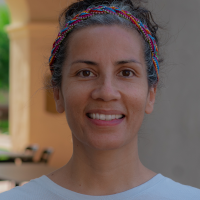 My ancestry es Muisca, African and South European de Colombia. Como inmigrante en los United States (U.S.), I completed a Ph.D. in Family Therapy at Nova Southeastern University (2011). Mi trabajo de supervisión, teaching, research, and therapy in my immigrant English are informed by the Australasian narrative therapy and U.S. Black feminism. En my Español Colombiano y Spanglish, I am particularly interested in Andean decoloniality, anti-racist feminismos and Chicanx borderland activismo as a response to Eurocentrism. I am a practicing licensed Marriage and Family Therapist en los Estados de California and Texas and AAMFT Supervisor.